Saturday, 11 February 2012


Similarities between 
Charlemagne en Genghis Khan


There are many similarities between Genghis Khan and Charlemagne, which are striking: Both men have unified their empire and can't decide on a successor amongst their sons. Both divide the empire up into three parts and give each part for their sons to reign over as equals. In both one of the sons gets worked out of his share. For both men historians do not exactly know how they died with rumors from the consequences of a Hunt, fall from a Horse or even a lung disease: pneumonia.


Genghis Khan is by contemporary history regarded as the founder of the Chinese empire, but A. Fomenko makes a very good case in showing that Genghis Khan or Batu-Khan was in fact the founder of the Russian Horde.


And Genghis Khan is no less the Great Prince or Batu Khan! Or if you like the great Man as in Charlemagne.


But how and why came the Great Russian Khan super-imposed on western history to figure as its archetype and represent the start of its history? Or was Austrasia, this name having so little in common with Frankish Princes really in Asia, that is Eastern Asia. Or if you like East Russia? And was Neustria then not New Russia? Let us not forget that even our western history in the end leads the origin of the family of the Pepins to... White Russia!


Like Charlemagne who receives his heritage from his grandfather Charles Martel, Genghis Khan receives his heritage from Khabul Kahn, or again the great Kahn (Khabul = akhbar = great).


Genghis Khan born Temujin Khan married  Börte and
that is not a stretch far from Bertha Charlemagne's mother and wife of Pepin the short. Börte came from Olkhunut or Olgghirat, which contrary to sources who want Genghis Khan to be chinese, was in Hungary or White Russia and that's exactly where Pepin's Bertha's origins are. 


There was a mysterious disappearance of Börte in the form of a kidnap or marriage to a rival party and by now we are no longer surprised that also Pepin's Bertha came into trouble. And as for Börte's son Jochi who allegedly resulted from the liason during the kidnap, also Bertha had to fight for her children's heritage, because of disputed lawfulness. 


But in the end  Börte  became the grand empress of the golden Horde and her son Jochi did become the successor after which Genghis Khan mysteriously disappears from the scene, allegedly having died, but his grave kept unknown.


The golden Horde was a feudal order with local princes paying tribute and 10% taxes to the great Khan. 


A feudal system like this existed in western Europe also, but it was not as unified and solidified as in Russia. Since it was not possible for the russion 'Horde' to politically establish their order outside the borders of its own territory means were established which were essentially commercial. 


For this reason after 1100AD cities developed in Europe, which had a commercial bond with Russia. These were the 'Hanse' cities or the commercial nodes of the Khan. This means that as early as 1100 Russia had the means to establish commercial links, where cities were founded at regular distance from each other.


There remains one 'void' to fill, which we established previously in our research of Charlemagne. This was Charlemagne's link to Rome (italian rome that is) and the Papacy. Have we stumbled here upon the major difference between Charlemagne and the great Khan of Russia? Or does the history of Charlemagne tell us something about an aspect which is lost in what history tells us about Genghis Khan?

Friday, 20 January 2012

the Golden Age

Charlemagne in context

After the time of Charlemagne the world became divided into four regions and Charlemagne - whose name is in fact a title more than a persons real name - was a reflection of the Emperor who wasn't. His personal name of 'David' how he liked to be called amongst confidentes is not merely accidental. 


In the super imposed connection with Rome as described earlier the Charlemagne period really reflects two things. One: the failure of the first Roman project and two: the hands behind the scenes of this failed project. In the Old Testament, which is written well after the New Testament, this failure is adequately described in the fall of Babylon. 


The world, through the failure of the Roman-Charlemagne project, fell entirely into disarray, but first into four parts.
- Ethiopia
- Niger
- Romae
- Iudea Romana


The Patriarchates of  those four regions were:
- Ethiopia: Antiochia or Indian Goa (founded by apostle Thomas)
- Niger     : Alexandria (Apostle Peter and therefore Prime
                                        Patriarchate)
- Romae  :  Ravenna
- Iudea Romana : I(e)R(u)Salem  or City of Iudea Romana


Through the 'world' conquest of Alexander the Great the world capital became Alexandria and the failed project of Babylon (Romae) became superimposed on Alexandria, for which reason it was known also as Roma (as a singular now). 


It was from here that the 'Pope' Victor (African!) started the first imperial demands on other churches regarding the date of Easter.


A. Fomenko for that reason seems correct regarding the Chronology issues  and the dividing up of the world into four regions must have happened at the time where regular chronology positions the failed project of Charlemagne. In fact it is confirmed by the actions and behaviour of for instance Charles the Hammer.

This becomes very obvious, because - even according to regular chronology - the world in the XI-XIV century matches exactly the divisions marked by the cross on above map.


- The Byzantine Empire had a Judaic form of Catholicism, quite distinctly different from the later Latin version.
- The Ethiopian form of Iudaic Christianity was the basis for later Islam, claiming for instance the South of Spain...
- Alexandria and Cairo may very well have been the same cities, since Cairo just means that Caer=City. It was in that form the Imperial world capital before the world fell apart in four regions. 
- Romae with the Christian patriarchate in Ravenna.  Although the whole region was called 'Romae' the city of Rome (Babylon) was not even a Christian city. It was governed by the Pagan Love cult of Cybele and may well may have been the original Babylon.


Around that time the Judaic Christian (and even pagan) creeds were not at odds with each other at all and though they developed with different distinct characters in the four corners of the world, they were in unity with all their differences. Moreover, they were tolerant.


That would soon change. After the world falls apart in four regions - again due to the failed project of Charlemagne - the world fell into a long period of war and the religious creed fell apart into four distinct religious forms, which resembled each other in many ways. Only later around XVII century they grew very much apart, with each their own distinct scriptures, customs and dogmas.


Hence regular Chronology is wrong when it claims that the world after Charlemagne fell apart in two creeds, namely the Orthodox Chruch and the Latin Church. The world fell apart in four different creeds, namely: 
- Christianity   (hostile to Iudaic Catholicism or Orthodox creed)
- Judaism         (Far from what is Judaism now, original Orthodox)
- Islam             (same as above, another form of Orthodox creed)
- Hinduism      (again same as above)
Each of those creeds developed in their own distinct regions: Christianity - Europe - Romae
Judaism - Greece/Turkey - Russia
Islam - Niger/EurAsia  - Afro Ethyopia
Hinduism -  South Asia - Asian Ethyopia.


Friday, 2 September 2011

Roman French Masonry

Roman French Masonry

Freemasonry in the West is of french origin, but it came from the East. The word francmason for freemason gives the tale away. Franc of course meaning free. This angle is rarely underlined in masonic literature. Either the literature will say that it originated with England in the 18th century from stone mason guilds - explaining that the word free meant, free from actual physical work on masonry to speculate on spiritual things building a spiritual temple of people  - or that it is very ancient in nature. 


Is there any information available, which would support this idea? And if positive are there further arguments to underpin this idea?


"As is well known to students of Masonic history, (though not to all Masons by any means), there is in existence a class of MSS. known as the "Old Charges" of Freemasons, but which would more appropriately be termed "Legendary Histories of the Craft of Masonry." The known copies of these number about eighty and are to be found in the possession of Lodges, individuals, libraries and museums. Until a comparatively recent date they were unpublished, but now nearly all are obtainable in printed form. The earliest of them, the "Halliwell" or "Regius" MS., dates from about 1390 A.D.; the next oldest, the "Cooke," from about 1450 A.D.; while the others originated at irregular intervals extending down well into the last century. The extreme value of these documents in relation to the Craft is universally recognized."

One of the oldest traditions of Freemasonry recorded in these MSS. histories, is that which connects with the fraternity Charles Martel, who, at the battle of Tours, in A. D. 732, turned back the tide of Saracenic invasion of Europe. In its earliest form it read thus:--

"And thus was that woorthy Crafte of Massonrey Confirmed in the Countrey of Jerusalem And in many other Kyngdomes. "Curious Craftes men walked aboute full wyde in Dyu's Countries soome to Learne more Crafte and conning and some to teache them that had but litle conning and so yt befell that their was on' Curious Masson that height Naymus grecus that had byn at the making of Sollomon's Temple and he came into ffrance and there he taught the Science of Massonrey to men of ffraunce And there was one of the Regall lyne of ffraunce that height Charles Martell And he was A man that Loved well suche A Crafte and Drewe to this Naymus grecus and Learned of him the Crafte And to vppon him the Chardges and ye mann's. And afterward by the grace of god he was elect to be Kyng of ffraunce. And when he was in his Estate he tooke Massons and did help to make men Massons yt weare none and sett them A woorke and gave them bothe the Chargs and mann's and good paye that he had learned of other Massons And confirmed them A Charter from yere to yeare to holde their assembly wheare they woulde, And churrishe them right much And thus came the Crafte into ffraunce." (1)

More than seventy later versions of the "Old Charges" repeat the story in much the same language. Three, the Cooke, the William Watson, and the Henery Heade MSS., (one older and two later than the Grand Lodge No. 1), denominate this legendary patron of the Craft "Carolus Secundus." Not one mentions Charlemagne and yet in recent years the attempt has been made, with some success, to substitute Charlemagne for both Charles Martel and "Carolus Secundus" in this legend. (2)
  1. 1 - Quoted from the Grand Lodge MS. No. 1 of the "old charges." This MS. bears date A.D. 1583 and is printed in Hughan's "Old Charges" (1872), p. 41, Sadler's "Masonic Facts and Fictions" (1887), p. 199; Quatuor Coronati Antigrapha, Vol.
  2. 2- A.Q.C. vol. XVIII, p. 179; Ib. vol. XIX, p. 45.
(from The Builder 1915)

The son of the widow - an important figure in Masonic ritual lore - then is no other than Charles Martel, or Charles the Hammer. It is well known that the Russian Communism was largely dominated by the French Grand Orient Lodge. The communist hammer and sickle symbol then is a slight reminder of Charles the Hammer, Charles Martel that is. 


But of course there should be much more to arrive at such a conclusion. The most important feature of Western Masonic symbolism is that of two pillars. The two pillars of divide between Church and State, between spiritual and political power. And here we have as matter of fact one of the most important give-aways. 


Any Roman Catholic historian and theologian will underline that it was the Roman Catholic Church, which gave the West the idea of a divide between Church and State. It was not known as such as a principle in the Byzantine view of the political, since as was the case in the Anglican world later, the Emperor was the head of both powers. 


The Pepins as creators of the vision of Charles Martel were the first to introduce spiritual realm for the Roman bishop to support a Franc political order the Western world. No co-incidently could this order only be created by isolating and distancing the West from the ancient order of the universal world and its other three regions: Byzantium, Asia and Africa.


Saturday, 6 August 2011

Donation of Pepin

Donation of Pepin


The situation up to the Franco Pepin vision of the - for the time being - Western World was in fact a world divided into four regions of which the main region was Byzantium. It is hence obvious that there were four patriachs of the Imperial Church and that did not include Rome. Hence there was no such thing as Roman Catholicism before Charlemagne and even then the use of the term catholic was a fiction not a fact since the Carolingian Church was not universal even at a glance. Of course Roman history found an easy solution to that problem: The whole world besides the Roman western world was this large unknown entity still to be discovered after the Renaissance.

Not by any chance was this the case. The early Chinese imperial state of affairs were too similar to those in Byzantium to not have any connections. Not by accident were all the families involved in the 'discoveries' of the world after the Renaissance had been established refugees or newcomers from.... the Byzantine Empire. 


These four regions of the world then were the Western World with a Patriarch in Ravenna, the Byzantine empire with a Patriarch in Constantinople, the Southern Mediterranean (African) region with a Patriarch in Alexandria, who was in fact Pope and the Asian region with a Patriarch in Antiochia. The Rome in Italy had been abandoned after the project of a unified global empire had failed. It may very well have been the true Babylon, namely the city of the Pepins, Bobone Orsini Babi-on.


The donation of Pepin to the old discarded city of Rome was a first attempt to restore these state of affairs. But it did not last very long for several reasons. There still were those four Imperial regions and its unifying emperor in Byzantium. 


You can't deny that the Pepins were bold and had vision. But since the Donation of Pepin - later renamed donation of Constantin - was by and large a fraud, it only follows that all the privileges claimed through the Donation were a fraud too. Well, a fraud as far as Constantin was concerned, not a fraud as far as the Pepin-Orisinis were concerned, because it was a blueprint of their vision. But non of the privileges claimed did actually exist before then.


  1. Constantin desires to promote the Chair of Peter over the Empire and in its seat on earth by bestowing on it imperial power and honor.
  2. The chair of Peter shall have supreme authority over all the churches in the world
  3. It shall be judge in all the concerns the service of God and the Christian faith
  4. Constantin had given him and his successors the phrygium - the tiara - and the lorum which adorned the Emperors neck.
  5. the Roman clergy shall enjoy the high privileges of the Imperial Senate being eligible for the dignity of Patrician.
  6. The Roman clergy shall ride on horses decked with white coverlets.
  7. This document was presented to Charlemagne by Adrian I in 774 claiming its authenticity
Of course non of it was authentic. And the outrage at the time by Byzantium (and many nobles in the West) says enough.

Saturday, 30 July 2011

Pepin Orsini vision

Pepin Orsini vision

With the Pepin Orsini dynasty the Franco-Roman order of history was set, which did not go unchallenged. Not only Byzantium firmly resisted, but perhaps underestimated, the vision of the Pepins. Also in the West not only the Lombardi viewed the attempts with great scepticism. Also the Bataves in the North were not charmed and resisted the attempts at curbing the freedoms of the Northern Peoples. In fact the Pepins threw Western Europe into a long frenzy of wars, which lasted to our day and age. 

We have to be somewhat sceptical about the missionary efforts of the new Franco Roman kingdom, claiming to have 'christianized' Western Europe. Christianity was around a lot longer, just not in the intolerant version as promoted by the Pepins and their Roman church. 

Moreover the Monastery became an important educational and military cell as initiated by Carloman, the first Pope of the new Roman Church. For this to be successful the ties with the Byzantine imperial church had to be cut and the West had to be isolated from the rest of the empire and the world, which is indeed what happened. 


We make a serious mistake if we assume that the Moors in Charles Martel's day were as religion comparable with modern Islam as even the New Roman Church established by the Pepins was far from comparable with what is now Roman Catholicism. 

When Charlemagne wished to be called David by his intimate circle it becomes clear where the primacy according to him was in the newly established order. When Charlemagne presided over Church councils he did just that what the Byzantine Emperor did. When Pepin the Short's brother Carloman relinquished his part of the empire for a spiritual function, both most likely assumed had chosen the most powerful part. 


We greatly suspect that when Charles Martel subdued the Moores in the Southern of France that he made a pact with them with the clear task of the Moores (or offer to them so to speak) to keep the Byzantium empire at bay. In fact the Moors would take over many features of the Byzantine empire in the coming centuries as long as they kept Western Europe isolated to enable it to put forth is own Novus Ordo.


There exists an interesting discovery when Napoleon seized the Pope in the 19th century. When he took with him the Papal Chair which had been in Rome since the time of Charlemagne and allegedly was the Chair where St. Peter had sat upon, he discovered that the chair contained an inscription referring to 'Allah' and it is indeed not impossible that Charles Martel obtained the chair when he subdued the Moors. 


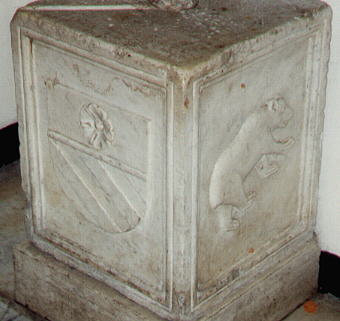
The name Orsini comes from Bear and the Bear has been linked with Charles Martel and the Pepins through the legend of Charles Martel killing a bear in his youth. The Pepins from that time took the attributes of the Bear. The name 'Ors' could also be rearranged to Rose another attribute in the heraldry of the Orsini.

The Orsini who were Bobone in older days hence are closely linked to the Pepins and most likely to Carloman. It is clear that without a Roman dynasty which linked to the Frankish Pepins Western civilization would not have developed the way it did. 

The first Stephen elected bishop of Rome died before being installed. The second Stephen (Bobone Orsini) until Adrian I had one clear vision, with the help of the Frankish Pepins to throw of the yoke of the Byzantine Emperor and the Exarchs in Ravenna. 

Monday, 25 July 2011

Two Pillars

Two Pillars

There were two factors which helped Charles Martel, who himself was not a legitimate son of Pepin of Herstal. Because Pepin's son died shortly before he died himself, he did not leave a legitimate heir and his grandson was too young still. The Moors from Spain tried to take advantage of the power vacuum and Charles Martel swiftly defended the Western part of the Empire. When he was afterwards requested to come to Byzantium though he did not follow the call of the Emperor. Charles Martel though did never become a king himself, but as Majordomo acted as such when he divided up the kingdom after his death in two parts for his sons Carloman and Pepin to become Majordomo for Austrasia and Neustria. 


These two sons effectively laid down the distribution of spiritual and worldly powers, which became the pillars for the Western Roman Catholic empire. Most of their lives the two sons worked together effectively and as such we only can assume that there is more to Carloman becoming a monk at Monte Cassino and leaving the Frankish empire to be unified by Pepin. Carloman was instrumental in subduing the Lombards in Northern Italy, who remained faithful to the Byzantine Empire and its Patriarch in Ravenna.


Hence both had to be eliminated and hence it was Carloman who factually established the area from Ravenna to Naples with Rome at its centre as domain in which the Roman Catholic Church could be established. As such Carloman left the Frankish empire to be unified by Pepin and received back the 'donation of Pepin', later fraudulently called the 'donation of Constantin'. 


In doing so a centuries long struggle was initiated as to who was the real power in the Catholic Empire, the worldly power or the spiritual one. Emperor or Pope. But neither was still there in the modern sense and although 'Pope' Gregor is regarded as the transition pope between the Byzantine empire and the new Frankish empire of course Gregor could not have been pope in the sense that later Roman Catholic Popes were. But since the whole process was initiated by Charles Martel we have to assume that the Pepin family very well knew what they were doing. 


Which leaves an interesting figure in between 'pope' Gregor and Pope Stephen. 'Pope' Zacharias after all was a Greek.


There exists an interesting legend:

"Ethelbert, King of Mercia and general monarch, sent to Charles Martel, the Right Worshipful Grand Master of France (father of King Pepin), who had been educated by Nimus Graecus, he sent over from France (about A.D. 710) some expert Masons to teach the Saxons those laws and usages of the ancient fraternity, that had been happily preserved from the havoc of the Goths"


According to Pritchard "one Carolus Marcil in France, was taught the art of Masonry by Mannon Grecus".

Was then the predecessor of Stephen then perhaps Mannon Graecus? In that case the real first pope was Stephen and he was only later associated to be of the Bobone family, which later became the Orsini family. Bobone and Pepin is not a far stretch and neither is Pepin and Stephen. In that case it was his own brother Carloman who anointed Pepin the Short as king of France. 


It may very well be that at the end of their lives the classic struggle between Pope and King set in and Pepin imprisoned his brother in Vienna, who still honours the fact in the Vienna Cathedral St. Stephen.  

And so Stephen (Carloman) became the first Martyr of the newly established Roman Catholic Church.

Saturday, 16 July 2011

Romus and Romulus

According to its myth Rome had twin founders Romus and Romulus. Rome existed as a twin city. Only later Romulus was regarded as its sole founder reflecting a more closed view at a later stage. 


Byzantium in fact was also called Roma Nova, which is reflected in the area West of the Black Sea called Romania with a European Latin language. The gypsies also are more commonly named 'Romae'. Rome existed as a twin city Old and New Rome, which was Old Rome and Byzantium.  Old Rome was the discarded and unfinished first Roman empire.


Romus and Romulus were, according to the myth, of Trojan descent and it will be of no surprise that also Charlemagne had a Trojan descent through Pepin of Landen's descent from Hector. A descent from the Northern Region of the Black Sea, with its capital Odessa with a Sarmarian form of Judaism.

If the future political ambitions of the Pepins were ever to become a reality then the bond between the Franks and the Emperor in Byzantium formed a problem. The Arian faith of the empire was Jewish Christian being tolerant of individual creeds, even Trinitarian ones. But gradually the Jewish nobility had deviated towards the leading positions in a thoroughly feudal system. The Merovingian kings were a reflexion of that situation. 

The Pepins gradually ran into problems with the centre of the Empire in Byzantium even to such an extent that they were excommunicated. The only solution was a revival of old Rome, but Ravenna and the loyal Lombardi constituted a problem. 

Charles Martel divides up the Frankish kingdom in three parts where each of his sons, Carloman, Pepin (the Short) and Grifo will act as Mayor Domo in their part. 

The names of the Pepin Mayors are sort of a mystery. Of course even the Kings in those days did not have any family names yet. Apparently blood and family was not institutionalised in those days. 

Charlemagne really is a title not a name, it was 'the great man' and Carloman was 'the (male) son of man'. Hence apart from Pepin there was very little to go for regarding their names.


Since Byzantium was not standing by idly they were in need of a supernatural form of authority. Carloman will found a base on Monte Cassino, a monastery functioning as a army very Templar like, and carves out the basis for the future of the Pepins, whilst paving the way for a unified Frankish kingdom under Pepin the Short. 

Most genealogies make of Pope Stephan II an Orsini. But the Orsinis in Rome rose to prominence only after the year 1000 and they very well may have been Pepins originally or Bobone for that matter, the Bobone-Orsini family. Most likely, since a Papacy was needed in a resurrected Rome it was Carloman himself taking up that role and hence Pepin the Short was anointed by his own brother.


Byzantium and those forces in Europe loyal to that order, would not stand by idle and hence the conditions were sown for a long period of European wars, which only are attempted to be consolidated in our days.